
The 85-decibel school: Why kids drain by noon

You pack their lunch, check their homework, and send them off to school to learn. But for many children, walking through the school doors feels like stepping onto a busy highway.
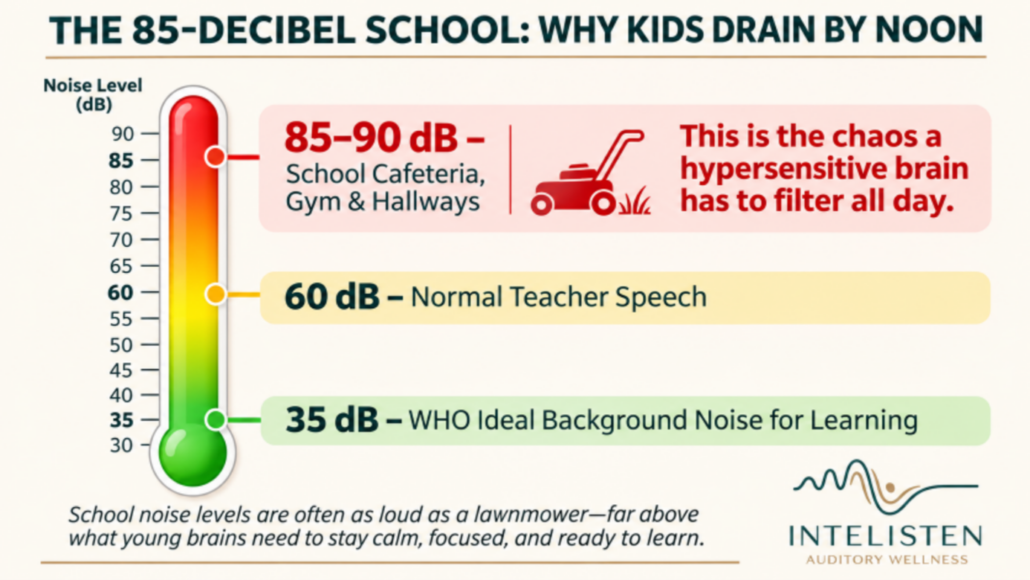
According to the World Health Organization’s (WHO) “Guidelines for Community Noise,” the maximum ideal background noise for effective learning and concentration is 35 decibels (dB). The reality of our educational environments, however, is drastically different. Comprehensive measurements led by Shield and Dockrell at London South Bank University reveal that an average classroom during simple group work operates at 65-75 dB.

Once children step out into the school hallways, the cafeteria, or the gym, noise levels frequently reach 75-90 decibels.

To put that into perspective, that is the acoustic equivalent of trying to study next to a running lawnmower or in the middle of heavy city traffic.


The invisible struggle of sensory overload

This is the chaos a hypersensitive brain has to filter all day.

For a child with auditory hypersensitivity, everyday sounds – the humming of fluorescent lights, the scraping of chairs, constant whispering, and coughing – continuously overload the sensory system. Because this struggle is invisible, highly sensitive children are often mislabeled by their environment as disobedient, inattentive, or unmotivated.

The truth is much more exhausting.

These children are not acting out; rather, constant noise filtering completely consumes their mental energy. Their nervous system is working overtime, fighting to block out disruptive, often physically uncomfortable background noise just to focus on the teacher’s voice. This immense cognitive load explains why these children often become completely drained, leading to irritability or “zoning out” by the second or third class of the day. By the afternoon, their sensory battery is entirely empty, frequently resulting in emotional “meltdowns” once they are finally in the safety of their home.


Shifting the threshold: how Auditory Wellness helps

How does a noise-sensitive child survive an 85-decibel school day?

While we cannot simply turn down the volume of the school environment, we can actively manage the child’s sound sensitivity and improve their tolerance.

The goal is not to force a child to “tough it out” or simply get used to painful sounds. Instead, Intelisten’s 10-day auditory wellness training targets the neurological adaptation process, helping the brain filter and process everyday sounds more efficiently.

By recalibrating how the brain perceives these frequencies, the training effectively pushes the child’s discomfort threshold upward, improving their natural noise tolerance. This does not mean they will never get tired again. What it means is that the training pushes back the boundary of sensory overload, allowing them to reach that same level of fatigue much later in the day.

When mental energy is no longer wasted on the constant, stressful filtering of background noise, it is finally freed up for what matters. Children regain the cognitive capacity to learn, to engage in social interactions, and to return home from school feeling balanced rather than broken.


What can you do RIGHT NOW? Take the first step to identify the problem. 

👉 Take our short questionnaire to see if Intelisten is right for you or your child.


Behind the scenes: creating personalized audio materials for people with sensitive hearing


For individuals with hypersensitive hearing, finding the right auditory environment can be life-changing. At Intelisten, we have developed a method to prepare personalized audio materials remotely—without ever needing to meet in person.

Here’s how we do it.

Read more

Managing noise sensitivity in daily life: practical strategies for a calmer environment


Noise sensitivity, also referred to as auditory hypersensitivity, can significantly impact daily life. Whether it’s the clatter of dishes, the hum of a washing machine, or the chatter in a crowded room, heightened sensitivity to sound can create discomfort, stress, and even pain for some individuals.

Understanding this challenge and finding practical ways to navigate it can lead to a more manageable and peaceful day-to-day experience.

Read more

Who are our costumers?

Understanding the challenges of hypersensitive hearing

Hypersensitive hearing is more than just a heightened reaction to sound. It can significantly affect daily life, especially for children, but also for adults. At Intelisten, we work with individuals experiencing hypersensitive hearing—a condition that often hides behind other, more familiar challenges.

Many of our clients arrive after long periods of confusion, seeking help for issues like difficulty concentrating, behavioral outbursts, or persistent speech errors. Only later do they learn that these challenges may stem from how their brain processes sound.

Read more

Learning improvement initiative

Boost your learning capabilities

Unlock your learning potential with Intelisten’s specialized 10-day listening course. Our program is designed to improve learning abilities for individuals impacted by sensitive hearing, a condition commonly associated with ASD, ADHD, and dyslexia.

Experience a comprehensive approach that targets perception and processing challenges to enhance your educational journey and overall quality of life.

Read more

Hearing sensitivity release program

Experience relief from sensitive hearing

Join our 10-day listening course to alleviate symptoms of hearing sensitivity and improve your quality of life. Our program has a remarkable 98% success rate in helping individuals with sensitive hearing, commonly associated with conditions like ASD, ADHD, and dyslexia.

Say goodbye to noise intolerance and enhance your learning and perception abilities with Intelisten’s proven approach.

Read more

Persistent headache in a 15-year-old boy

“My complaints completely disappeared on the 6th day of the training, and this condition has lasted ever since.”

My name is David, I am 15 years old. My problems started a year and a half ago. At first I had a mild headache, my GP suspected puberty and recommended pain relief. These made my life much easier for a few weeks, but I had to take the medicine almost every day, because the headache increased. My family and I went to the doctor again to find a sustainable and effective solution in the long term. Several months of examination began – cardiology, neurology, MR, ultrasound, X-ray, … –  but unfortunately none of them found the cause behind the headache.

My mother accidentally found information about hypersensitive hearing, and it’s true that I didn’t have any complaints about it at school, but when I was a small child, there were many things in my life that are typical for people with hypersensitive hearing.

We performed the necessary assessment and the result supported hypersensitive hearing. Since the training can’t hurt, we decided to give it a chance, even if it doesn’t cause significant changes, since we didn’t see any other solution that could work for me.

Finally, I completed the 10-day training at home in December 2023, it was especially pleasant to be able to choose the music myself. By the way, the filtered music was a bit strange, as if I had heard the sounds more muted, under water, but it was not unpleasant at all.

On the sixth day of the training, I did not wake up in the morning with a headache and did not need to take medicine. The intense headache hasn’t returned since then, and my everyday life has become much easier and more comfortable.
The customer service was very efficient, when I had a question they helped me immediately.

I’m so glad we found this listening training, it was worth every minute.


If you would like to find out what might be behind your difficulties, feel free to complete our free assessment. 

Symptom alleviation solution

Alleviate increased sound sensitivity symptoms

Discover relief from hearing sensitivity symptoms with Intelisten’s effective 10-day training program. Our specialized approach targets the root causes of sensitive hearing, offering a comprehensive solution for alleviating symptoms related to conditions like ASD, ADHD, and misophonia. Join the countless individuals who have benefited from our research-backed methodology, now available to help individuals in the US manage their hearing sensitivity effectively.

Experience a significant improvement in noise tolerance, perception, and processing abilities, enhancing your daily experiences and quality of life.

Read more

Noise tolerance enhancement

Enhance your tolerance to noise

Struggling with noise sensitivity? Our online training program targets noise tolerance enhancement to assist individuals coping with sensitive hearing. Experience a transformative 10-day course that addresses noise perception and processing challenges, often linked to conditions like Hyperacusis and Misophonia.

With over 15 years of success in Europe, Intelisten is dedicated to providing effective solutions for noise-related issues, now accessible in the US.

Read more

Diagnoses linked to sensitivite hearing

According to internet searches a lot of people are dealing with more sensitive hearing than avarage. This problem primarily affects children aged  5-10 but it is becoming increasingly coomon in adults as well. It may appear because hypersensitive hearing is a widespread problem in big cities nowadays where the noise level is huge (WHO – noise), and children are exposed to influences that their nervous system cannot process even at the gestational age. Hypersensitive hearing can be an accompanying symptom in the case of diagnosed children, and based on the experience of the past years, Intelisten can help dealing with this problem.

By alleviating the hearing sensitivity, the appearance of the other symptoms and the entire problem becomes milder.

Read more