The 107-decibel kitchen: Why everyday chores can cause physical pain
Washing dishes, unloading the dishwasher, or making a quick bowl of cereal shouldn’t feel like an endurance test. Yet for millions of adults, teens, and children with auditory hypersensitivity, the kitchen is one of the most stressful rooms in the house.
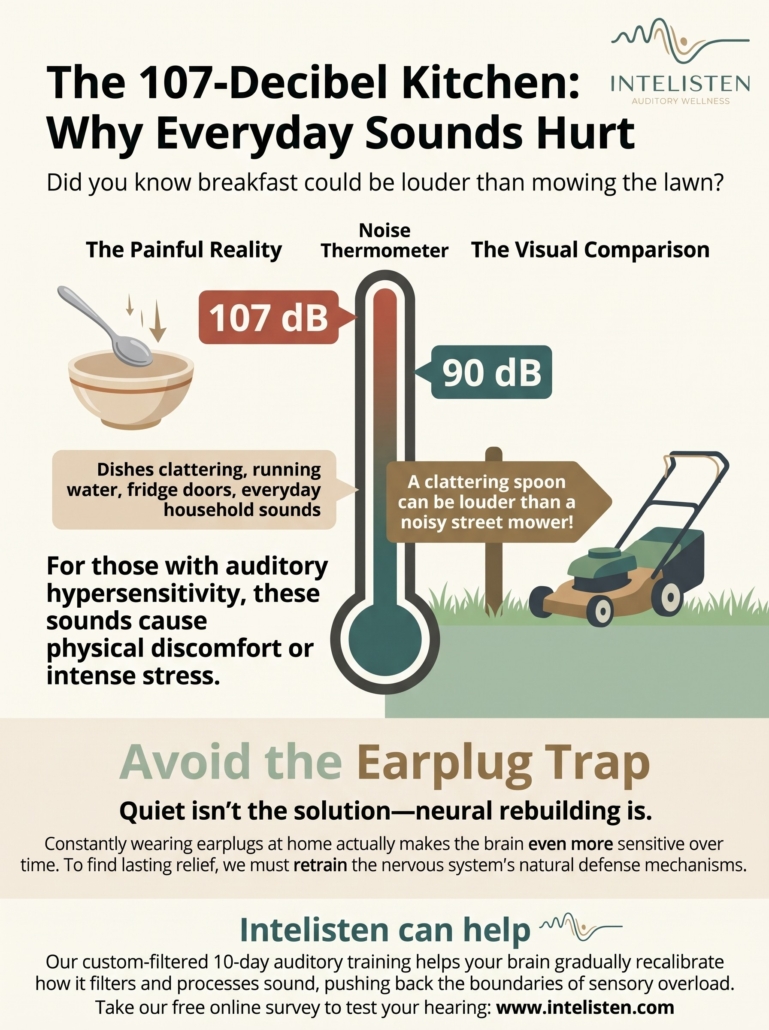
If you have ever winced at the clatter of silverware or felt an immediate wave of tension when someone turns on the faucet, you are not overreacting – the acoustics back you up. Audiological measurements examining sudden impact (“transient”) sounds – referenced in research from organizations such as Hyperacusis Research and the Journal of the American Academy of Audiology – have shown that simply dropping a metal spoon into a ceramic bowl can generate a peak sound pressure level of 105 to 107 decibels (Peak SPL).
For a split second, that everyday breakfast sound is louder than a running lawnmower (90 dB), heavy city traffic, or even the continuous noise of a jackhammer.
It’s not your ears – It’s the brain’s “Volume knob”
Most people barely notice the sharp clink of plates or the closing of a refrigerator door. Their ears pick up the sound, and their brain’s natural auditory filter immediately dampens it so it doesn’t register as a threat.
For someone living with hyperacusis (physical pain or discomfort from everyday sounds) or misophonia (intense emotional distress or anger triggered by specific noises), that internal filter doesn’t work the same way. Instead of adjusting automatically, the brain’s “volume knob” is stuck at 100%.
When a 107-decibel transient sound hits a hypersensitive nervous system, it doesn’t just register as loud – it can trigger an instant fight-or-flight response, physical ear discomfort, or sudden exhaustion. Over the course of a day, navigating running water, clattering pans, and background appliance hums drains your mental energy long before the evening even begins.
The earplug trap: Why blocking out sound can backfire
When everyday household chores feel unbearable, the most natural instinct is to reach for earplugs or noise-canceling headphones. Wearing them while unloading the dishwasher or cooking can offer immediate, welcome relief.
The challenge is that relying on constant sound blocking is only a short-term workaround. When you continuously deprive your auditory system of normal everyday frequencies, your brain often tries to compensate by turning its internal sensitivity up even higher. Over time, constant silence can actually lower your discomfort threshold, making sounds feel even sharper and more painful the moment you take the earplugs out.
Shifting the threshold instead of hiding from noise
You cannot live your life in a soundproof room, and you shouldn’t have to dread making breakfast. Real, lasting relief comes not from blocking out the world, but from helping your brain process sound more efficiently.
Thanks to neuroplasticity – the brain’s natural ability to adapt and form new neural pathways – the auditory system can be gently retrained. Rather than forcing yourself to “just get used to” painful noises through willpower, targeted auditory wellness training works with your nervous system safely and gradually.
At Intelisten, our 10-day at-home acoustic training program is built on more than 15 years of clinical and practical experience and over 4,000 completed programs:
- Personalized to Your Profile: Because every sensory system is unique – and generic or mismatched filtered audio can disrupt normal sound processing – we begin by identifying your specific trigger frequencies.
- Custom-Filtered Music: Using our specialized filtering system, we create personalized musical tracks that gently support your nervous system’s adaptation without exposing you to jarring acoustic triggers.
- Simple and Stress-Free: You listen for 30 minutes, twice a day, in the comfort of your own home – no travel and no stressful clinic visits.
The goal of auditory wellness training is to safely shift your discomfort threshold upward. When your nervous system is no longer on high alert from every clinking spoon or running tap, daily life becomes calmer, and your energy is freed up for the moments that actually matter.
Curious if auditory training could help you?
Many people have measurable sound sensitivity without it disrupting their lives, while for others, everyday noises take a serious toll on their daily well-being. Our initial online questionnaire acts as a simple pre-screening to help determine whether the Intelisten program is the right fit for you or your child.
What can you do RIGHT NOW? Take the first step to identify the problem.
👉 Take our short questionnaire to see if Intelisten is right for you or your child.
