
The 85-decibel school: Why kids drain by noon
You pack their lunch, check their homework, and send them off to school to learn. But for many children, walking through the school doors feels like stepping onto a busy highway.
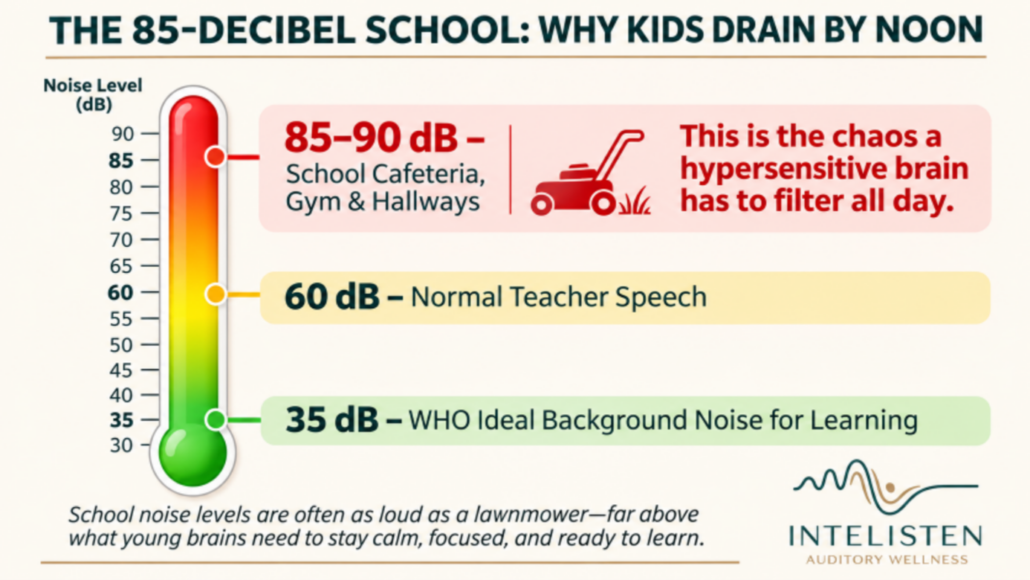 According to the World Health Organization’s (WHO) “Guidelines for Community Noise,” the maximum ideal background noise for effective learning and concentration is 35 decibels (dB). The reality of our educational environments, however, is drastically different. Comprehensive measurements led by Shield and Dockrell at London South Bank University reveal that an average classroom during simple group work operates at 65-75 dB.
Once children step out into the school hallways, the cafeteria, or the gym, noise levels frequently reach 75-90 decibels.
To put that into perspective, that is the acoustic equivalent of trying to study next to a running lawnmower or in the middle of heavy city traffic.
The invisible struggle of sensory overload
This is the chaos a hypersensitive brain has to filter all day.
For a child with auditory hypersensitivity, everyday sounds – the humming of fluorescent lights, the scraping of chairs, constant whispering, and coughing – continuously overload the sensory system. Because this struggle is invisible, highly sensitive children are often mislabeled by their environment as disobedient, inattentive, or unmotivated.
The truth is much more exhausting.
These children are not acting out; rather, constant noise filtering completely consumes their mental energy. Their nervous system is working overtime, fighting to block out disruptive, often physically uncomfortable background noise just to focus on the teacher’s voice. This immense cognitive load explains why these children often become completely drained, leading to irritability or “zoning out” by the second or third class of the day. By the afternoon, their sensory battery is entirely empty, frequently resulting in emotional “meltdowns” once they are finally in the safety of their home.
Shifting the threshold: how Auditory Wellness helps
How does a noise-sensitive child survive an 85-decibel school day?
While we cannot simply turn down the volume of the school environment, we can actively manage the child’s sound sensitivity and improve their tolerance.
The goal is not to force a child to “tough it out” or simply get used to painful sounds. Instead, Intelisten’s 10-day auditory wellness training targets the neurological adaptation process, helping the brain filter and process everyday sounds more efficiently.
By recalibrating how the brain perceives these frequencies, the training effectively pushes the child’s discomfort threshold upward, improving their natural noise tolerance. This does not mean they will never get tired again. What it means is that the training pushes back the boundary of sensory overload, allowing them to reach that same level of fatigue much later in the day.
When mental energy is no longer wasted on the constant, stressful filtering of background noise, it is finally freed up for what matters. Children regain the cognitive capacity to learn, to engage in social interactions, and to return home from school feeling balanced rather than broken.
What can you do RIGHT NOW? Take the first step to identify the problem.
👉 Take our short questionnaire to see if Intelisten is right for you or your child.
