
The 85-decibel school: Why kids drain by noon

You pack their lunch, check their homework, and send them off to school to learn. But for many children, walking through the school doors feels like stepping onto a busy highway.
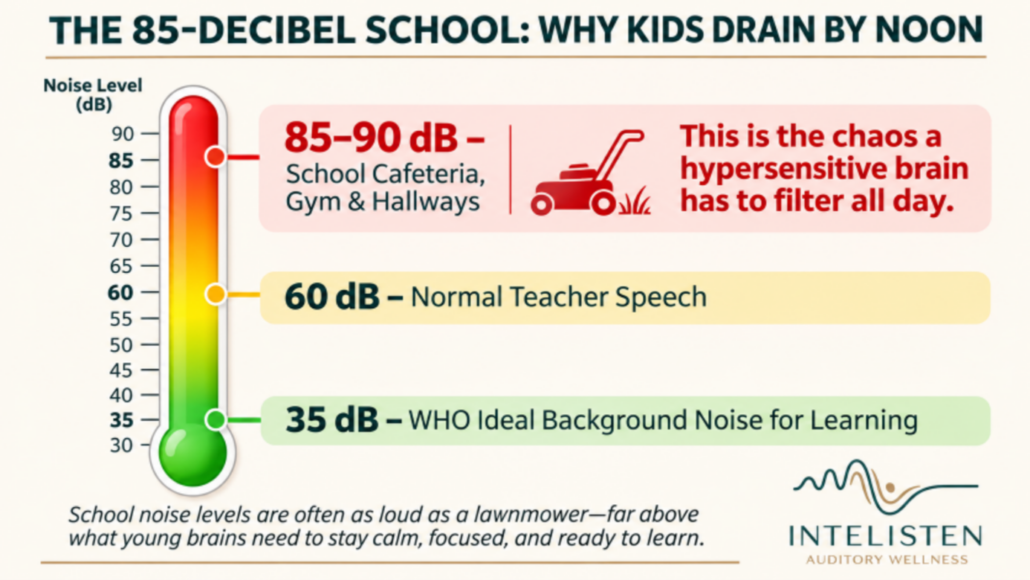
According to the World Health Organization’s (WHO) “Guidelines for Community Noise,” the maximum ideal background noise for effective learning and concentration is 35 decibels (dB). The reality of our educational environments, however, is drastically different. Comprehensive measurements led by Shield and Dockrell at London South Bank University reveal that an average classroom during simple group work operates at 65-75 dB.

Once children step out into the school hallways, the cafeteria, or the gym, noise levels frequently reach 75-90 decibels.

To put that into perspective, that is the acoustic equivalent of trying to study next to a running lawnmower or in the middle of heavy city traffic.


The invisible struggle of sensory overload

This is the chaos a hypersensitive brain has to filter all day.

For a child with auditory hypersensitivity, everyday sounds – the humming of fluorescent lights, the scraping of chairs, constant whispering, and coughing – continuously overload the sensory system. Because this struggle is invisible, highly sensitive children are often mislabeled by their environment as disobedient, inattentive, or unmotivated.

The truth is much more exhausting.

These children are not acting out; rather, constant noise filtering completely consumes their mental energy. Their nervous system is working overtime, fighting to block out disruptive, often physically uncomfortable background noise just to focus on the teacher’s voice. This immense cognitive load explains why these children often become completely drained, leading to irritability or “zoning out” by the second or third class of the day. By the afternoon, their sensory battery is entirely empty, frequently resulting in emotional “meltdowns” once they are finally in the safety of their home.


Shifting the threshold: how Auditory Wellness helps

How does a noise-sensitive child survive an 85-decibel school day?

While we cannot simply turn down the volume of the school environment, we can actively manage the child’s sound sensitivity and improve their tolerance.

The goal is not to force a child to “tough it out” or simply get used to painful sounds. Instead, Intelisten’s 10-day auditory wellness training targets the neurological adaptation process, helping the brain filter and process everyday sounds more efficiently.

By recalibrating how the brain perceives these frequencies, the training effectively pushes the child’s discomfort threshold upward, improving their natural noise tolerance. This does not mean they will never get tired again. What it means is that the training pushes back the boundary of sensory overload, allowing them to reach that same level of fatigue much later in the day.

When mental energy is no longer wasted on the constant, stressful filtering of background noise, it is finally freed up for what matters. Children regain the cognitive capacity to learn, to engage in social interactions, and to return home from school feeling balanced rather than broken.


What can you do RIGHT NOW? Take the first step to identify the problem. 

👉 Take our short questionnaire to see if Intelisten is right for you or your child.


Is the world too loud? You’re not alone… and there’s a way out


Does your child often cover their ears in everyday settings?
Do they seem tense, struggle to concentrate, or avoid noisy places like cafeterias or playgrounds?

What if these behaviors aren’t just “quirks” but SIGNALS?

What if their brain is overwhelmed by sound in ways most people can’t imagine?

When everyday sounds become too much

For some, even the hum of a refrigerator, clinking silverware, or joyful playground shouts can feel like an onslaught. These children (and many adults too) experience sound more intensely what we call hypersensitive hearing.

Not a diagnosis.

Not a disorder.

But a very real difference in how the brain processes noise.

This can lead to:

  • Emotional withdrawal

  • Fatigue after short periods of focus

  • Avoidance of social or loud environments

  • Misunderstanding instructions or struggling with speech clarity

And most importantly: it makes everyday life harder than it needs to be.


It doesn’t have to stay this way

There’s a powerful shift that can happen in just 10 days.

The Intelisten auditory training is designed specifically for people who struggle with noise tolerance, sound clarity, or auditory confusion. It gently tunes the brain to process sound more efficiently, reducing overload, increasing comfort, and bringing confidence back into daily life.

No diagnoses, no labels, just real change, felt in real life.


What does change look like?

Imagine…

  • Sleeping through the night without noise-induced stress

  • Joining in a group conversation without confusion or fear

  • Being able to enjoy a trip to the cinema, playground, or café — like everyone else

Less noise. More freedom.
Less frustration. More confidence.
Less discomfort. More joy.
Less fear. More living.


What should you do RIGHT NOW? Take the first step to identify the problem. 

👉 Take our short questionnaire to see if Intelisten is right for you or your child.

Questions?

💬 Reach us directly – we’re here to listen.


Is your child reacting differently to everyday sounds? You might be overlooking something important.


Does your child often cover their ears, even when the noise doesn’t seem that loud? Do they appear overwhelmed in group settings, struggle to understand speech in noisy environments, or mispronounce words despite long-term speech support?

These may seem like small quirks, but they’re not as typical as many believe.

These behaviors often point to a specific kind of auditory sensitivity, an unusually heightened hearing ability that distorts how the brain processes sound. And no, it’s not something you just have to accept.

Children with hypersensitive hearing may react strongly to sounds that others easily ignore. They may tire quickly in class, seem inattentive, or even appear to ignore instructions, not out of defiance, but because their brains are overloaded trying to filter through every single sound.


Here’s the good news: you can help them.

Intelisten’s unique auditory training doesn’t rely on therapy or one-size-fits-all solutions. It targets the root of the issue, how your child’s brain perceives sound. In just ten days, children often begin to tolerate everyday noise better, improve in speech clarity, and show noticeable gains in attention and confidence (for example, Intelisten).

The first step? Identifying whether your child might be affected.

👉 Take our short questionnaire to find out more.


Questions?

💬 Reach us directly – we’re here to help.


Why everyday earplug use might be making your hearing sensitivity worse


For anyone struggling with sound sensitivity, the instinct to protect your ears with earplugs or noise-cancelling headphones is completely understandable. After all, these tools are widely used to prevent hearing damage in loud environments—and they work extremely well when used for that purpose.

But what happens when these protective devices become part of everyday life, even in situations where the noise levels aren’t actually harmful?

Read more

Behind the scenes: creating personalized audio materials for people with sensitive hearing


For individuals with hypersensitive hearing, finding the right auditory environment can be life-changing. At Intelisten, we have developed a method to prepare personalized audio materials remotely—without ever needing to meet in person.

Here’s how we do it.

Read more

Managing noise sensitivity in daily life: practical strategies for a calmer environment


Noise sensitivity, also referred to as auditory hypersensitivity, can significantly impact daily life. Whether it’s the clatter of dishes, the hum of a washing machine, or the chatter in a crowded room, heightened sensitivity to sound can create discomfort, stress, and even pain for some individuals.

Understanding this challenge and finding practical ways to navigate it can lead to a more manageable and peaceful day-to-day experience.

Read more

Who are our costumers?

Understanding the challenges of hypersensitive hearing

Hypersensitive hearing is more than just a heightened reaction to sound. It can significantly affect daily life, especially for children, but also for adults. At Intelisten, we work with individuals experiencing hypersensitive hearing—a condition that often hides behind other, more familiar challenges.

Many of our clients arrive after long periods of confusion, seeking help for issues like difficulty concentrating, behavioral outbursts, or persistent speech errors. Only later do they learn that these challenges may stem from how their brain processes sound.

Read more

Learning improvement initiative

Boost your learning capabilities

Unlock your learning potential with Intelisten’s specialized 10-day listening course. Our program is designed to improve learning abilities for individuals impacted by sensitive hearing, a condition commonly associated with ASD, ADHD, and dyslexia.

Experience a comprehensive approach that targets perception and processing challenges to enhance your educational journey and overall quality of life.

Read more

Quality of life enhancement

Improve your overall quality of life

Experience a holistic improvement in your quality of life with Intelisten’s transformative 10-day listening course. Our program targets hypersensitive hearing issues that impact daily living and learning abilities, offering relief and enhanced well-being. With a proven success rate of 98%, our specialized approach addresses noise tolerance, perception challenges, and processing difficulties commonly associated with conditions like ASD, ADHD, and Hyperacusis. Take the first step towards a better quality of life and unlock the potential for improved experiences and well-being with Intelisten.

Our program targets hypersensitive hearing issues that impact daily living and learning abilities, offering relief and enhanced well-being.

Read more

Hearing sensitivity release program

Experience relief from sensitive hearing

Join our 10-day listening course to alleviate symptoms of hearing sensitivity and improve your quality of life. Our program has a remarkable 98% success rate in helping individuals with sensitive hearing, commonly associated with conditions like ASD, ADHD, and dyslexia.

Say goodbye to noise intolerance and enhance your learning and perception abilities with Intelisten’s proven approach.

Read more